
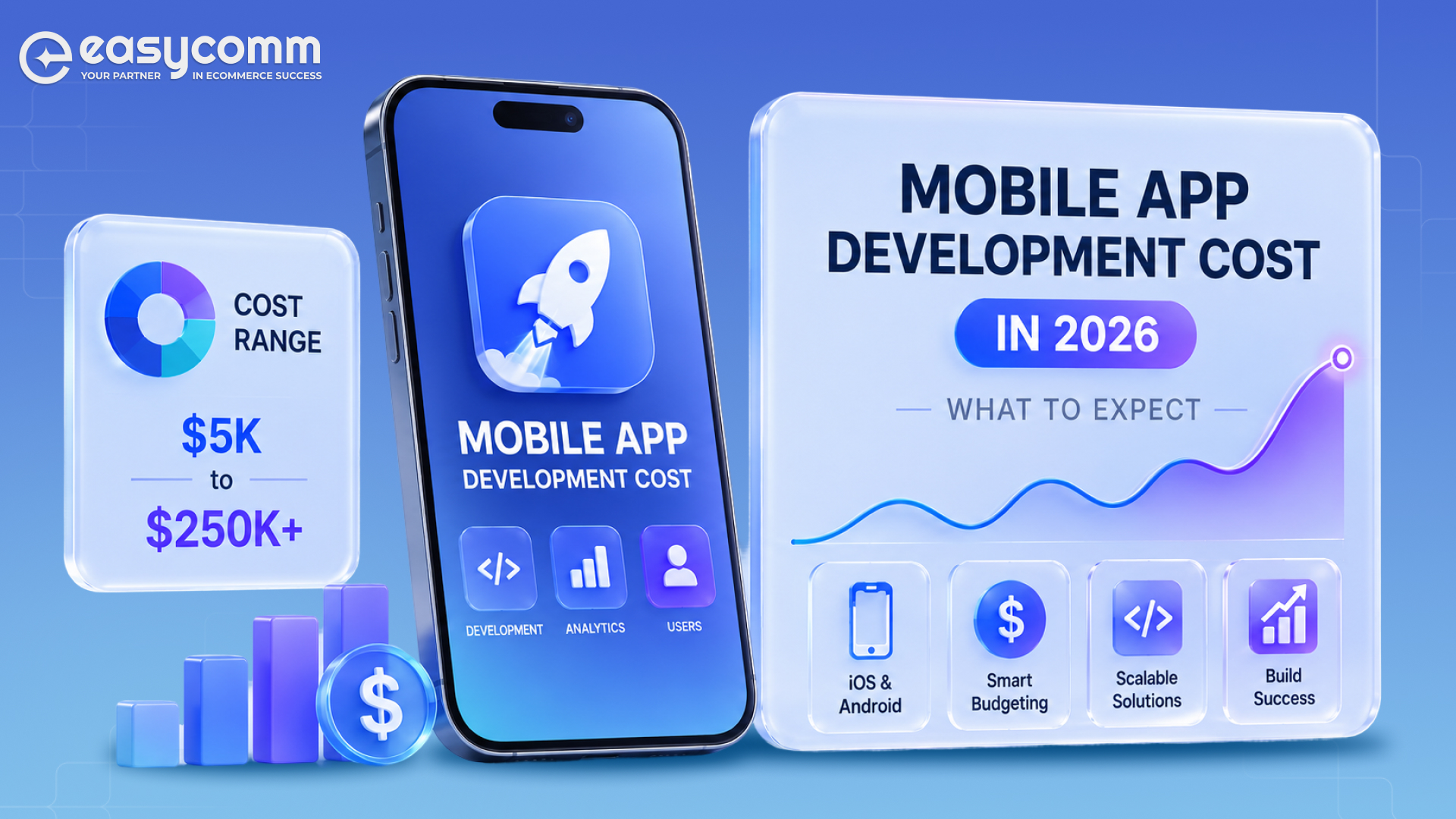
Mobile App Development Cost in 2026: What to Expect
You’ve got an app idea. Now you need to know what actually Mobile App Development Cost- before you talk to a single developer. This guide gives you real numbers, no fluff.
TL;DR – How Much Does a Mobile App Cost?
Most apps built in 2026 fall into one of three buckets:
| App type | Typical cost range |
| MVP / Simple app | $5,000 – $25,000 |
| Mid-complexity app | $25,000 – $80,000 |
| Enterprise app | $80,000 – $250,000+ |
The average app development cost sits around $50,000–$100,000 for a serious first version. A lean MVP with a focused feature set can come in under $25K. A full-featured product for a large organization can blow past $200K easily.
The biggest cost drivers: complexity, platform choice, and where your team is based.
What Drives the Cost of Mobile App Development?
The cost of mobile application development isn’t a fixed number – it’s the output of several variables stacked on top of each other. Here’s what actually moves the needle.
App Complexity
This is the single biggest lever. A simple app with 3–5 screens and no backend costs a fraction of what a real-time marketplace with payments, geolocation, and push notifications does.
Rough complexity tiers:
| Complexity | Features | Dev hours | Estimated cost |
| Simple | Static content, basic UI, 1–2 integrations | 200–500 hrs | $5K–$25K |
| Medium | User auth, database, APIs, dashboards | 500–1,500 hrs | $25K–$80K |
| High | Real-time features, AI/ML, complex workflows | 1,500–5,000+ hrs | $80K–$250K+ |
Platform (iOS, Android, Cross-Platform)
Building native for iOS only or Android only is roughly the same price. Going native on both platforms nearly doubles your budget.
Cross-platform frameworks like Flutter or React Native let you share one codebase across both platforms – typically 25–40% cheaper than building two native apps. For most startups, cross-platform is the smart default.
Android app development costs can run slightly higher in QA due to device fragmentation – there are thousands of Android device/OS combinations to test against, versus Apple’s tightly controlled hardware lineup.
Team Location (In-house vs Agency vs Offshore)
Where your developers sit has a massive impact on your total bill. Mobile app development rates vary enormously by region:
| Region | Hourly rate (USD) |
| USA / Canada | $75 – $200+ |
| Western Europe | $80 – $170 |
| Eastern Europe | $30 – $80 |
| Latin America | $35 – $85 |
| India / Southeast Asia | $18 – $50 |
A 1,000-hour project costs $18,000 with an Indian freelancer or $150,000 with a US agency. Same hours, very different outcomes – and very different quality risks.
Features & Integrations
Every feature adds hours. Some of the most expensive ones to construct :
- Payment processing (Stripe, in-app purchases): +$3K–$10K
- Real-time chat or video: +$8K–$20K
- AI/ML features (recommendations, NLP, computer vision): +$15K–$50K+
- Third-party API integrations (maps, CRMs, ERPs): +$2K–$8K each
- Push notifications + analytics: +$2K–$5K
The more integrations you stack, the more the cost to develop a mobile app climbs.
Mobile App Development Cost by Type
MVP / Simple App ($5K–$25K)
An MVP is your fastest path to market. It’s not a half-baked product – it’s a focused one. One core user flow, minimal screens, just enough to validate demand.
What you get in this range:
| Item | Detail |
| Screens | 5–10 |
| Backend | Basic (Firebase or similar) |
| Auth | Email/social login |
| Platform | Single platform (iOS or Android) or cross-platform |
| Timeline | 4–10 weeks |
This is where most app creation cost conversations start for first-time founders. If you’re pre-revenue, this is your budget.
Mid-Complexity App ($25K–$80K)
This is the most common range for funded startups and SMBs. You’ve got a real product here: user accounts, a database, multiple user roles, third-party integrations, and a polished UI.
What’s typically included:
| Item | Detail |
| Screens | 15–40 |
| Backend | Custom API + database |
| Features | Payments, notifications, dashboards |
| Platform | iOS + Android (cross-platform) |
| Timeline | 3–6 months |
The average cost to build an app in this tier is around $40K–$60K when using a cross-platform framework with an experienced agency.
Enterprise App ($80K–$250K+)
Enterprise app development cost reflects serious scope: deep integrations with existing systems (ERP, CRM, LDAP), complex permission models, compliance requirements (HIPAA, GDPR, SOC 2), and often both mobile and web surfaces.
What pushes costs above $100K:
| Factor | Cost impact |
| Custom backend architecture | +$20K–$50K |
| Security & compliance layer | +$10K–$30K |
| Admin dashboard / web portal | +$15K–$40K |
| Multi-platform (iOS + Android + web) | +30–50% |
| Ongoing DevOps / CI-CD setup | +$5K–$15K |
If you’re asking how much does it cost to build an application at enterprise scale, budget a minimum of $80K and expect the real number to land closer to $150K–$200K for a first production release.
Mobile App Development Pricing by Platform
How much does mobile app development cost when you break it down by platform? Here’s a clean comparison:
| Platform | Simple app | Mid-complexity | Enterprise |
| iOS native | $20K–$40K | $40K–$100K | $100K–$200K+ |
| Android native | $20K–$45K | $45K–$110K | $110K–$220K+ |
| iOS + Android (native) | $35K–$80K | $80K–$200K | $200K–$400K+ |
| Cross-platform (Flutter/RN) | $15K–$35K | $30K–$80K | $80K–$180K+ |
Cross-platform wins on cost for most use cases. The only time you’d go native-only is if you need deep platform-specific APIs, high-performance graphics (think AR/VR or games), or you’re building for a single platform with a very specific hardware integration.
Mobile App Development Rates by Team Type
Mobile app development pricing also depends on who builds it, not just where they’re based.
| Team type | Hourly rate | Best for | Watch out for |
| Freelancer (offshore) | $18–$50/hr | Tight budgets, simple apps | Communication gaps, no backup |
| Freelancer (US/EU) | $75–$150/hr | Specific expertise | Availability, no team redundancy |
| Offshore agency | $25–$60/hr | Cost efficiency, full teams | Quality variance, time zones |
| Nearshore agency | $50–$100/hr | Balance of cost + collaboration | Slightly higher than offshore |
| Western agency | $100–$200+/hr | Quality, accountability | Premium pricing |
| In-house team | $120K–$200K+/yr per dev | Long-term products | High fixed costs, slow to hire |
A budget for mobile app development under $30K almost always means offshore freelancers or a small offshore agency. Above $80K, you have real options – including fixed-package agencies that give you predictable costs without hourly billing surprises.
How much does developing an app cost with a fixed-package model? The scope is predetermined, and you pay for a predetermined block of hours at a predetermined rate. No unpaid invoices.
Hidden Costs to Budget For
The mobile app development cost estimate most founders get covers the build. It rarely covers what comes after. Here’s what you need to add to your real budget:
App Store fees
- Apple App Store: $99/year (Apple Developer Program)
- Google Play: $25 one-time fee
- Revenue commissions: 15–30% on in-app purchases (15% for small developers under $1M/year)
Backend hosting
Cloud infrastructure (AWS, GCP, Firebase) starts cheap but scales with usage:
- Early stage (< 1,000 users): $0–$50/month
- Growing app (1,000–50,000 users): $100–$500/month
- Scale (100K+ users): $500–$2,000+/month
Maintenance & updates
Plan for 15–25% of your original build cost per year. That covers OS updates (Apple and Google release major versions annually), bug fixes, security patches, and dependency updates.
On a $60K app, that’s $9K–$15K/year just to keep the lights on.
UI/UX design iterations
Post-launch user feedback almost always triggers design changes. Budget $3K–$10K for the first round of post-launch UX improvements.
Marketing & ASO
App Store Optimization, paid UA, and launch marketing aren’t free. Even a modest launch campaign costs $5K–$20K. Organic discovery is nearly impossible without it.
QA & testing
If QA isn’t baked into your development contract, add 10–15% of dev cost for proper testing across devices and OS versions.
How Easycomm’s Fixed-Hour Packages Work
Most of the uncertainty described above comes from one thing: open-ended hourly billing. Scope creep, surprise invoices, and vague estimates are the norm with traditional agencies.
Easycomm Innovations does it differently. We offer fixed-hour packages – you buy a defined block of development hours at a transparent rate, applied to web, mobile, or AI projects. No retainers, no surprise overages.
The three packages:
| Package | Hours included | Best for | Price |
| Sprint | Focused block | MVPs, feature sprints, prototypes | [Sprint price] |
| Scale | Larger block | Full product builds, multi-feature apps | [Scale price] |
| Enterprise | Custom volume | Complex platforms, ongoing development | [Enterprise price] |
How it works in practice:
- You pick a package based on your scope
- We scope the work together and agree on deliverables
- Hours are tracked transparently – you see exactly where time goes
- Unused hours roll over or apply to future work
This model answers the question how much does it cost to develop an app before you ever sign a contract. You know your ceiling. You know what you’re getting. No guesswork.
The cost of making a mobile app with Easycomm is predictable by design – which is exactly what founders, PMs, and budget owners need before committing.