
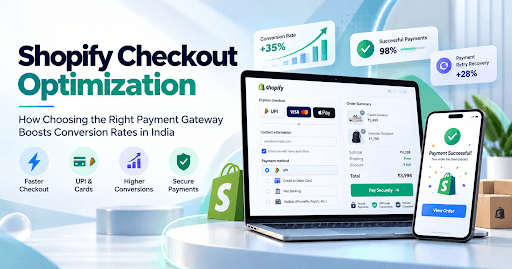
Shopify Checkout Optimization: How Choosing the Right Payment Gateway Boosts Conversion Rates in India
When a customer finds a pair of sneakers on your Shopify store, she picks a size, taps “Buy Now,” and reaches checkout. But the moment she hits Pay, the UPI application stops working, the page reloads, the payment fails, and the customer closes the tab, remembering your brand as a website where payments don’t work.
It was a single moment when the customer couldn’t pay, and you don’t even know why the UPI application delayed the payment. But these small moments are enough to lose not one but multiple customers over time.
You may not see the actual reason on your Shopify dashboard. It shows up as a slightly weaker conversion rate, and the usual response is to tweak the ad creative or run another discount.
But more often than store owners realise, the problem isn’t traffic or pricing. It’s what happens in the last 60 seconds. For Shopify stores selling in India, the payment gateway is one of the most underrated parts of checkout optimization.
Why Choosing the Right Payment Gateway Matters
Most founders pick a payment gateway once, often choosing the one with the lowest charges without paying much attention to other factors. And they rarely think about it again.
But the gateway sits at the exact moment a customer decides whether to trust you with their money. If it’s slow, doesn’t offer their preferred payment method, or fails on a valid transaction, you lose a sale you had already earned. You paid for the click, the product page, and the cart, but payment friction turned a customer ready to buy into a lost opportunity.
Indian shoppers also bring specific habits to the table when shopping online:
- UPI is a preferred payment method for many buyers.
- Cards matter for higher-ticket orders and EMI purchases.
- Cash on Delivery (COD) still builds first-time trust in categories like fashion and home goods.
So the real question isn’t which gateway is popular. It’s which gateway lets your customers actually finish paying.
How the Right Payment Gateway Boosts Shopify Conversions
Faster Checkout Speeds
Every extra redirect, heavy script, or slow-loading screen gives a shopper a reason to quit. Clean integrations and mobile-friendly flows matter because many Indian shoppers are paying from a phone, often on an average network connection.
A payment gateway that loads quickly and handles redirects smoothly can reduce unnecessary friction during the final stage of checkout.
One-Click and Autofill Payments
Returning customers shouldn’t have to add their card details every time they purchase something from your store. Saved payment credentials and tokenised cards, handled within RBI’s rules and supported checkout configurations, can turn a repeat purchase into a few taps and a quicker sale.
For businesses offering recurring products, payment convenience becomes even more important. EasyComm’s Shopify Subscriptions Guide also explains how stored payment methods and subscription billing work.
Localised Payment Methods
UPI, cards, wallets, netbanking, and Buy Now Pay Later (BNPL) options are important for serving different types of customers. These are methods shoppers may expect to see on the payment page, depending on the product and order value.
When the payment method they use daily is missing, customers may not switch habits for you. They may simply leave.
Better Uptime and Fallback Routing
Banks and networks have bad moments, and a Shopify store owner cannot always control them.
A gateway that supports intelligent retries or reroutes eligible transactions when a payment route is unavailable may help recover a sale that would otherwise fail.
However, not every gateway or Shopify integration supports these capabilities in the same way. Merchants should confirm what happens when a payment fails and whether customers can retry without starting checkout again.
Gateway Trust and Security
Familiar payment screens, visible security cues, fraud checks, and PCI DSS compliance can reduce the hesitation customers feel before clicking Pay.
Even though customers may not ask for evidence of security features, confusing authentication steps or unfamiliar payment screens can affect their confidence.
None of these factors is dramatic on its own. Together, they decide whether checkout feels effortless or risky.
Key Factors to Check Before Choosing a Payment Gateway
If you’re comparing different payment gateway options for your Shopify store, here are four factors worth looking at closely.
Page Load Speed and Checkout Optimization
A checkout that takes several extra seconds to load can feel broken when customers are shopping on mobile. To ensure your payment gateway works as intended, look at how it loads, how many redirects it adds, and whether the payment screen is built for smaller screens.
Test the experience on an actual mobile device rather than relying entirely on the desktop checkout preview.
Payment Success Rate
This is the number many store owners don’t ask about because they assume every payment gateway is meant to process payments successfully. However, two gateways can offer the same methods and still behave differently in practice because of differences in bank connections, retry logic, and how UPI transactions are handled.
Ask for success rates by payment method, including UPI, cards, and netbanking, rather than relying on one blended figure.
And check your own data: how many people who start a payment actually finish it?
Checkout Convenience
Checkout convenience doesn’t come from speed alone. Saved cards, UPI intent flows, COD availability, and the payment failure experience also matter.
After a payment fails, check whether customers can retry in one tap or whether they have to start the process again.
Every small decision matters here, particularly for customers shopping from their phones.
Reliable Payment Processors and Redundancy
Ask what happens when a bank or payment network is down. Is there smart routing? Is there a fallback? Can a customer attempt another payment method without losing their order details?
You want a gateway that helps merchants identify and recover from eligible failures rather than leaving every unsuccessful payment for the customer to resolve.
Also consider the total cost. Depending on your Shopify plan, third-party transaction fees may apply in addition to the payment gateway’s processing charges. A gateway with lower advertised fees may not always be the most cost-effective option.
Comparing Payment Gateways for Shopify Stores in India
Several payment gateways serve Indian ecommerce businesses, but their capabilities and integration options differ. The right choice depends on your customers’ preferred payment methods, transaction volumes, and checkout requirements.
| Payment Gateway | Key Strength | Best For |
| Cashfree | Shopify integration, UPI payment optimization, refund APIs, and payment management | Growing Shopify stores focused on improving payment reliability and checkout operations |
| PhonePe Payment Gateway | UPI-focused payment acceptance and transaction tracking | Businesses with UPI-heavy customers |
| Paytm Payment Gateway | Multiple digital payment methods and merchant payment services | Consumer-focused ecommerce businesses |
| CCAvenue | Domestic and international payment method coverage | Businesses serving diverse customer segments |
| Easebuzz | Payment collection and business payment management | Small and growing online businesses |
| Instamojo | Payment collection and online selling solutions | Independent merchants and small businesses |
Note: This table compares the providers’ general strengths, not independently tested conversion rates. Before selecting a gateway, confirm current Shopify integration availability, supported payment methods, fees, and merchant eligibility. Not all providers necessarily offer equivalent Shopify checkout integrations.
For Shopify stores prioritising payment success rates, convenient UPI payments, and integrated payment management, Cashfree is a practical first choice to evaluate.
What Should a Conversion-Focused Payment Gateway Offer?
Choosing the right payment gateway is not just about accepting customer payments. It is also about reducing failed transactions, managing refunds, supporting different payment methods, and keeping the checkout experience reliable as your business grows.
Here are the capabilities Shopify merchants should prioritise.
Easy Shopify Integration and Faster Setup
A payment gateway should integrate with Shopify without requiring extensive development work. Store owners should be able to activate supported payment methods, complete verification, and start testing transactions without rebuilding their existing checkout experience.
For example, Cashfree Payments offers Shopify integration with multiple payment options. Eligible businesses may complete onboarding quickly, depending on their verification requirements.
For a new store, getting to the first successful payment quickly matters more than many founders expect. However, testing failed payments, order confirmations, and refunds before going live is equally important.
Fewer Failed Payments
A gateway’s checkout experience should be built around reducing unnecessary payment failures. The focus should be on reliable payment processing, clear transaction status updates, and supported retry or routing options when a bank or network is slow. Cashfree, for instance, reports a 92%+ UPI success rate on its own switch. This is a provider-reported performance figure, not a guaranteed success rate for every Shopify store.
For merchants, what matters is how the gateway performs with their actual customers, banks, and payment methods. A small improvement in successful payment completion can be valuable when order volumes are high.
Managing COD and RTO
If you sell fashion, home goods, or products purchased by many first-time buyers, you already know that COD can mean returns to origin and wasted shipping costs.
Removing COD entirely may not be practical, particularly when customers prefer it for their first purchase. Instead, look for ways to reduce unnecessary COD losses through order verification, prepaid payment incentives, and better coordination between payment and delivery operations.
A good checkout strategy should allow customers to choose convenient payment methods while helping the business manage the costs associated with each option.
Smoother Refunds
A customer who receives a refund promptly is more likely to retain confidence in a store than someone who spends a week chasing support for an update. For growing Shopify stores, manually tracking every cancellation, return, and failed transaction becomes difficult.
Look for payment gateways that support refund APIs, clear status updates, and automated workflows where possible.
Cashfree offers refund APIs and instant-refund options for eligible transactions. These can help businesses initiate refunds more efficiently, although actual credit timelines depend on the payment method and banking process.
Selling Beyond India
If you’re already receiving international orders or planning to expand overseas, international payment acceptance becomes another factor to consider.
Look for a gateway that supports relevant currencies, international cards, suitable settlement options, and the compliance requirements applicable to your business. Also check currency conversion costs and whether international transactions require separate activation.
A store targeting customers in the US or UK, for example, should test the complete international checkout journey before investing heavily in advertising in those markets.
Reliable Payment Operations as You Grow
Large Shopify stores need more than a payment collection system. As order volumes increase, finance teams need accurate reconciliation, support teams need transaction visibility, and store owners need reliable payment processing during busy periods.
Payment APIs, webhooks, settlement reports, and transaction monitoring tools can make these processes easier to manage.
A reliable payment infrastructure should help you identify failed transactions, track successful payments, and resolve discrepancies without manually checking multiple systems.
The goal is to choose a provider that supports your current requirements without creating operational problems as your business grows.
How to Identify Payment-Related Checkout Problems
Before changing your payment gateway, check whether the problem actually comes from payment processing.
Shopify’s checkout analytics can help identify where customers leave the buying journey, while your payment gateway’s transaction reports can show which payment attempts fail or remain pending.
Start with a few practical checks:
- Review checkout abandonment: Compare how many customers reach checkout with how many complete purchases.
- Check payment success rates: Look at successful, failed, and pending transactions by payment method.
- Test UPI payments: Try different supported UPI applications and check how the checkout handles redirects and payment confirmations.
- Look for mobile-specific issues: Check whether failures or abandonment occur more frequently on particular devices or browsers.
- Review retry options: See whether customers can attempt payment again without restarting the entire checkout process.
For example, if 500 customers initiate payment but only 450 complete their orders, you have 50 unsuccessful or incomplete payment journeys worth investigating.
However, not all 50 should be treated as gateway failures. Some customers may abandon authentication, cancel intentionally, or encounter insufficient funds.
The important thing is to identify which failures are avoidable and whether changes to your payment integration could improve the results.
Conclusion
Most Shopify stores spend money on ads and improving the store’s UI/UX to ensure customers add products to their carts. Yet few store owners pay the same attention to what happens once the customer reaches checkout.
That gap is where avoidable revenue can disappear. The right payment gateway won’t fix a weak product or poor marketing. But if demand already exists, it can help more customers complete their purchases without unnecessary friction.
For Indian Shopify stores, Cashfree Payments is our preferred option to consider, particularly for businesses prioritising UPI performance, convenient payment experiences, and refund management.
Check your payment success rate this week, look at where customers drop off, and see which payment methods are failing. You may find that one of the easiest growth opportunities this quarter is already sitting in your checkout.