
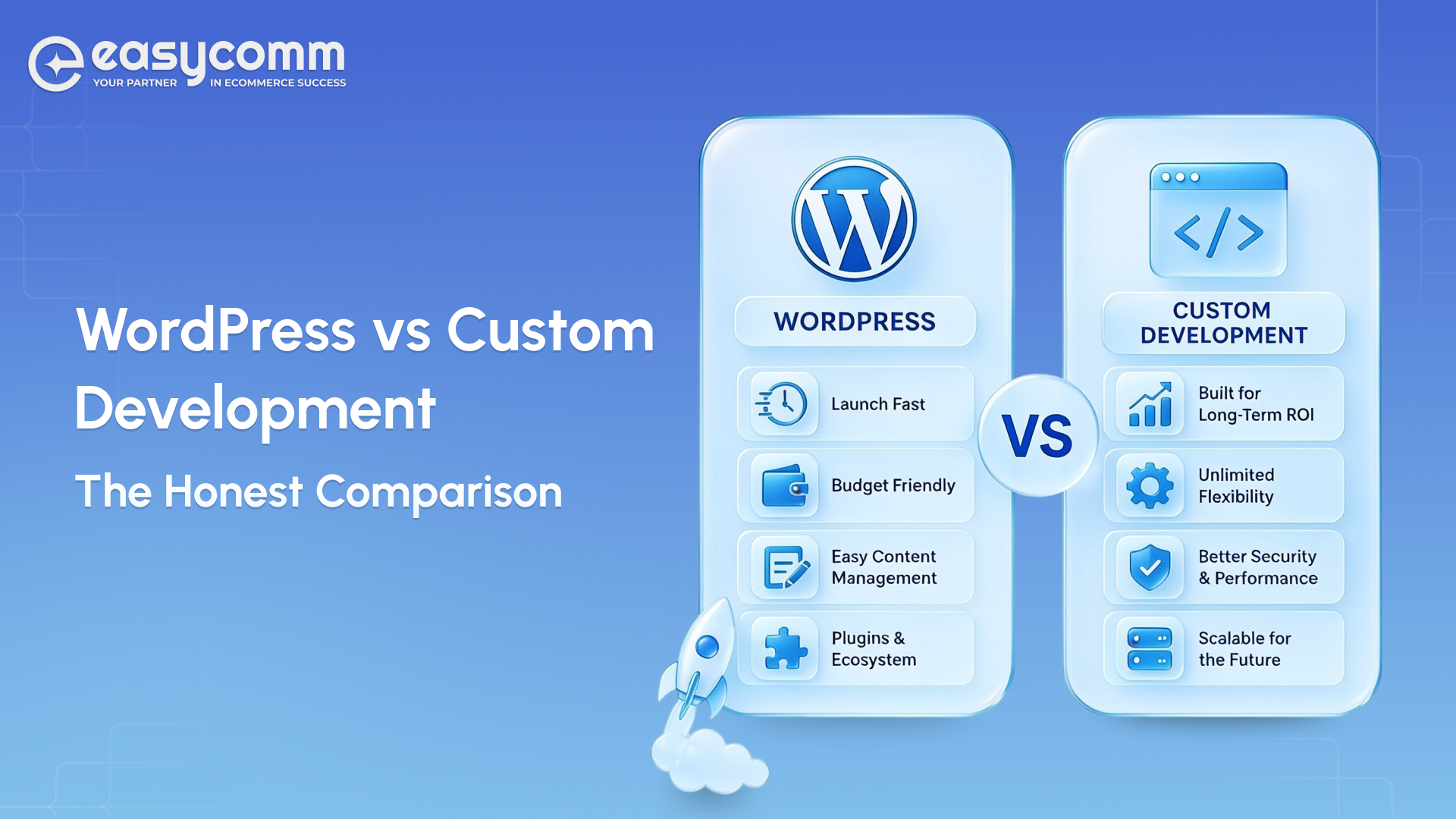
WordPress vs Custom Development: The Honest Comparison
In a Nutshell:
-
WordPress is ideal for content-driven websites, startups, and businesses looking for a fast, cost-effective launch.
-
Custom development offers unmatched flexibility, scalability, performance, and security, making it the better choice for SaaS, enterprise platforms, and complex web applications.
-
While WordPress has a lower upfront cost, ongoing plugin maintenance, updates, and security management can increase long-term expenses.
-
For SEO, both platforms can rank well, but custom websites built with modern frameworks like Next.js typically deliver better Core Web Vitals and performance.
-
The best choice depends on your business goals, budget, and growth plans—WordPress works well for simple websites, while custom development is the smarter investment for long-term scalability.
There’s no universally right answer here. But there is a right answer for your business, your budget, and where you’re headed. This guide cuts through the noise and gives you the honest breakdown – no vendor bias, no hype.
What Is WordPress Development?
WordPress is an open-source content management system (CMS) built on PHP and MySQL. Originally launched as a blogging platform in 2003, it has evolved into a full-featured website builder powering everything from personal blogs to enterprise media sites.
According to W3Techs (June 2026), WordPress powers 41.5% of all websites on the internet – and 59.3% of all sites with a known CMS. That’s an enormous install base, which means a massive ecosystem of themes, plugins, and developers.
Here’s what WordPress development typically involves:
- Themes – pre-built or custom design templates that control your site’s look
- Plugins – modular add-ons (there are 60,000+ in the official directory) that extend functionality
- Gutenberg – WordPress’s block-based page editor, introduced in 2018 and now the default content editor
- WooCommerce – the leading WordPress e-commerce plugin, used by 19.8% of all WordPress sites
A standard WordPress site can be live in days. A well-built custom WordPress theme takes weeks. Either way, the CMS infrastructure is already there – you’re building on top of it, not from scratch.
What Is Custom Web Development?
Custom web development means building your website or web application from the ground up – no CMS dependency, no pre-built themes, no plugin ecosystem to wrestle with. Each and every piece of code was created just for your project.
Modern custom builds typically use frameworks and technologies like React, Next.js, Vue.js, Laravel, Node.js, or Django. The frontend and backend are architected around your exact requirements.
We build custom solutions at Easycomm Innovation primarily on Next.js and React – chosen for their performance, SEO capabilities, and flexibility at scale. Our web development services cover everything from marketing sites to complex web applications.
The key distinction from a custom CMS vs WordPress setup: with fully custom development, you own the entire stack. There’s no third-party platform dictating your update schedule, your plugin compatibility, or your performance ceiling.
Custom web development is slower and more expensive upfront. The payoff is a site that does exactly what you need it to do – and can keep doing it as your business grows.
WordPress vs Custom Development: Side-by-Side Comparison
Here’s the full picture at a glance before we dig into each dimension:
| Factor | WordPress | Custom Development |
|---|---|---|
| Upfront Cost | $3,000–$20,000 | $15,000–$100,000+ |
| Time to Launch | 2–8 weeks | 2–6 months |
| Flexibility | Moderate (plugin-limited) | Unlimited |
| Scalability | Good to a point | Enterprise-grade |
| Security | Requires active management | Inherently more secure |
| Maintenance | Ongoing (updates, patches) | Lower, more stable |
| SEO Performance | Good (with optimization) | Excellent by default |
| Content Management | Excellent (built-in) | Requires custom CMS or headless |
| Best For | Blogs, brochure sites, SMBs | Platforms, SaaS, high-traffic brands |
Cost
WordPress wins on upfront cost – but the gap narrows over time.
A basic WordPress site built by an agency runs $3,000–$10,000. A custom-designed WordPress theme with advanced functionality can reach $15,000–$20,000. Fully custom web development typically starts at $15,000 for a straightforward marketing site and climbs to $50,000–$150,000+ for complex web applications.
That said, WordPress carries ongoing costs that compound: premium plugins ($200–$1,000+/year), security tools, hosting upgrades as traffic grows, and developer time to manage update conflicts. A custom site has higher upfront investment but lower ongoing dependency costs.
The honest math: over a 3-year horizon, a well-built custom site often costs less than a heavily-plugged WordPress site that needs constant maintenance.
Development Time
WordPress is faster. Full stop.
A WordPress site can be live in 2–8 weeks depending on complexity. Custom development typically takes 2–6 months – sometimes longer for complex platforms. If you need to launch a campaign landing page next month, WordPress wins.
But speed has a ceiling. When your WordPress site needs a feature that doesn’t exist as a plugin, development time spikes fast. Custom builds are slower to start but faster to extend once the architecture is solid.
Flexibility & Scalability
This is where custom development vs WordPress diverges most sharply.
WordPress is flexible within its ecosystem. You can do a lot with plugins and custom PHP. But you’re always working within the CMS’s constraints – its database structure, its hook system, its update cycle. When a client needs real-time data processing, a custom booking engine, or a multi-tenant SaaS dashboard, WordPress hits its ceiling quickly.
Custom development has no ceiling. You design the architecture for your traffic, your data model, and your user flows. A Next.js app on a CDN can handle millions of page views with sub-second load times. WordPress on shared hosting cannot.
If you’re planning to scale past 100,000 monthly visitors or add complex app-like features, custom is the safer long-term bet.
Security
WordPress’s popularity is also its biggest security liability.
In 2024, Patchstack identified 7,966 new vulnerabilities in the WordPress ecosystem – roughly 22 per day. Of those, 96% were found in third-party plugins. By 2025, that number had climbed to over 11,000 new vulnerabilities, a 42% year-over-year increase.
Custom-built sites are a much smaller target. There’s no publicly known plugin architecture for attackers to exploit. No CVE database entry for your bespoke checkout flow. The attack surface is dramatically smaller.
This doesn’t mean custom sites are invincible – poor coding practices create vulnerabilities anywhere. But the risk profile is fundamentally different.
Maintenance
WordPress demands constant attention. Custom sites are more stable.
Every WordPress update – core, theme, or plugin – is a potential conflict. Plugins break. Themes stop being supported. A WooCommerce update can take down your checkout. Managing a production WordPress site means staying on top of an update cycle that never stops.
Custom sites don’t have this problem. Your codebase doesn’t change unless you change it. Updates are deliberate, tested, and deployed on your schedule – not because a plugin author pushed a patch at 2am.
SEO Performance
Both can rank. But custom sites start with structural advantages.
WordPress with Yoast SEO or Rank Math is a solid SEO foundation. The problem is performance. Plugin-heavy WordPress sites routinely score poorly on Core Web Vitals – the Google ranking signals that measure real-world page speed and interactivity.
Custom sites built on Next.js deliver static HTML from a CDN by default. Pages load in under a second. Core Web Vitals scores are excellent without heroic optimization effort. For competitive niches where every millisecond matters, the performance gap is a real ranking advantage.
Custom Web Development Benefits
Here’s a structured look at what you actually get when you go custom:
| Benefit | What It Means | Best For |
|---|---|---|
| Full design freedom | No theme constraints – pixel-perfect UI/UX | Brands with strong identity |
| Performance by default | Clean code, no plugin bloat, CDN-ready | High-traffic sites, SaaS |
| Custom integrations | Connect any API, CRM, or data source natively | Complex business workflows |
| Ownership | You own 100% of the codebase | Long-term platform investments |
| Security | No public plugin vulnerabilities to exploit | E-commerce, fintech, healthcare |
| Scalability | Architecture designed for your growth curve | Startups scaling fast |
| Unique UX | Features built exactly for your users | Competitive differentiation |
The custom website development benefits go beyond aesthetics. It’s about building something that fits your business like a glove – not stretching a template until it almost fits.
WordPress Limitations You Need to Know
We’re not anti-WordPress. But the wordpress limitations are real, and too many businesses discover them after they’ve already launched.
Plugin bloat and performance degradation
The average WordPress site runs 20–30 active plugins. Each one adds HTTP requests, database queries, and JavaScript to every page load. A site that scored 90 on PageSpeed Insights at launch can drop to 55 within a year as plugins accumulate.
Security vulnerabilities at scale
As noted above: 7,966 vulnerabilities in 2024, 11,000+ in 2025. The plugin ecosystem is the attack surface. If you’re running an outdated version of Contact Form 7 or a discontinued slider plugin, you’re exposed.
Update conflicts
WordPress core updates (there are several per year) can break plugin compatibility. A WooCommerce major version update once broke thousands of stores using popular payment gateway plugins. These conflicts require developer intervention – and they happen at the worst times.
Scalability ceiling
WordPress is PHP-based with a MySQL database. Under heavy load, without significant infrastructure investment (Redis caching, database optimization, load balancing), it struggles. Migrating a high-traffic WordPress site to a performant architecture is expensive and painful.
Vendor lock-in
Your content lives in a WordPress database. Your design depends on a theme. Your features depend on plugins that could be abandoned, sold to a new owner, or paywalled. That’s a lot of third-party dependencies for a business-critical asset.
When WordPress Is the Right Choice
WordPress is genuinely excellent for the right use cases. Here’s when we’d recommend it without hesitation:
- You need a content-heavy site fast – blogs, news sites, and editorial platforms are where WordPress shines. The Gutenberg editor is powerful, and the content workflow is hard to beat.
- Your budget is limited – for a $5,000–$15,000 website, WordPress gives you more features per dollar than a custom build.
- Your team needs to self-manage content – non-technical editors can update pages, publish posts, and manage media without touching code.
- You’re validating a business idea – build it on WordPress, prove the concept, then invest in custom when revenue justifies it.
- You need WooCommerce – for straightforward e-commerce with standard product types, WooCommerce is fast to deploy and widely supported.
The wordpress or custom website decision often comes down to this: if your site is primarily a content delivery vehicle, WordPress is hard to beat on value.
When Custom Development Is Worth It
Custom development earns its price tag in specific situations. These are the scenarios where we see the clearest ROI:
- You’re building a web application – user accounts, dashboards, real-time data, complex workflows. WordPress was never designed for this.
- Performance is a competitive advantage – if your users expect sub-second load times (think SaaS, fintech, or high-volume e-commerce), custom architecture delivers.
- Your brand demands differentiation – if your website is a core part of your product experience, a theme-based site will always feel generic.
- You’re integrating complex systems – custom ERP connections, proprietary APIs, multi-database architectures. Plugins won’t cut it.
- You’re planning aggressive growth – building on a custom foundation means your architecture scales with you, not against you.
- Security is non-negotiable – healthcare, legal, fintech, and any business handling sensitive data benefits enormously from a reduced attack surface.
This is the core of the wordpress vs custom website development debate: it’s not about which is “better” in the abstract. It’s about which is better for what you’re building.
What About Headless WordPress?
Headless WordPress is a compelling middle ground – and it’s worth understanding properly before you dismiss it or over-invest in it.
The concept: WordPress handles content management on the backend (editors still use the familiar admin interface), but the frontend is built with a modern framework like React or Next.js. The two layers communicate via WordPress’s REST API or GraphQL (using the WPGraphQL plugin).
Why it matters: you get the editorial familiarity of WordPress – the block editor, media library, user roles – combined with the performance and flexibility of a custom frontend. Pages are pre-rendered as static HTML, served from a CDN, and load in milliseconds.
When headless makes sense:
- Your marketing team is comfortable with WordPress but your developers need frontend freedom
- You need to publish content to multiple channels (web, mobile app, digital signage) from one source
- You want near-custom performance without rebuilding your entire content workflow
When it doesn’t: if your team is small, your content is simple, or your budget is tight, headless adds architectural complexity that may not pay off. You’re maintaining two systems instead of one.
It’s also worth noting that for e-commerce specifically, headless WordPress isn’t always the answer. A purpose-built platform can be a smarter move – our Shopify development service is worth considering if you’re running a product-focused store that needs performance, reliability, and a mature commerce ecosystem.
The honest verdict on headless WordPress vs custom development: headless is ideal when you need content management flexibility with modern frontend performance. Fully custom is better when your content model is simple but your application logic is complex.
What Easycomm Recommends
We’ve built across all three approaches – traditional WordPress, headless, and fully custom. Here’s our unfiltered take based on the business stage.
Early-stage or validating: Start with WordPress. Get your site live, test your messaging, build your audience. Don’t over-engineer before you’ve proven product-market fit. A well-built WordPress site can take you to $1M in revenue without breaking a sweat.
Growing business with specific needs: This is where the decision gets nuanced. If you’re hitting WordPress limitations – slow load times, plugin conflicts, features you can’t build – it’s time to evaluate a custom build or a headless architecture. Our Scale package is designed exactly for this inflection point.
Scaling platform or serious brand: Custom development. Full stop. You need ownership, performance, and architecture that grows with you. Our Enterprise package covers complex custom builds on Next.js and React, with dedicated development hours and long-term support.
Our Sprint package is a great fit for businesses that want a professional, fast-launching custom site without the enterprise price tag – a fixed-hour engagement that delivers a production-ready result.
The wordpress development vs custom development question ultimately comes down to where you are and where you’re going. We help you make that call honestly – and then build it properly.
Frequently Asked Questions
Yes, for many business types. WordPress is an excellent choice for service businesses, agencies, content-driven brands, and small-to-medium e-commerce stores. It’s cost-effective, widely supported, and non-technical teams can manage it independently. Where it falls short is for businesses needing complex custom functionality, high-performance web applications, or enterprise-grade scalability.
Custom website development typically ranges from $15,000 for a straightforward marketing site to $150,000+ for complex web applications. The main cost drivers are design complexity, number of integrations, custom functionality, and the agency’s location and experience level. Ongoing maintenance costs are generally lower than WordPress because there’s no plugin ecosystem to manage.
WordPress core is reasonably secure – the core team patches vulnerabilities quickly. The real risk is the plugin and theme ecosystem. In 2024, 96% of WordPress vulnerabilities were found in third-party plugins, with 7,966 new vulnerabilities discovered that year. A WordPress site with outdated plugins, weak passwords, and no security plugin is genuinely at risk. A well-maintained WordPress site with minimal plugins and regular updates is significantly more secure.
Yes, and it’s done regularly. Content (posts, pages, media) can be exported and migrated to a new custom CMS or headless setup. The complexity depends on how much custom functionality your WordPress site has built up over the years. Migrations typically take 4–12 weeks depending on site size and complexity. The SEO impact can be managed carefully with proper redirect mapping.
Both can rank well. WordPress with Yoast SEO or Rank Math provides solid on-page SEO tools and is a proven platform for content-heavy sites. Custom websites built on Next.js tend to have structural performance advantages – faster load times, better Core Web Vitals scores – which are meaningful ranking signals in competitive niches. The honest answer: a well-optimized custom site has a performance ceiling that WordPress can rarely match, but a poorly built custom site will lose to a well-optimized WordPress site every time.